Inclusion and diversity within staffing at golf course turf operations is something imperatvie to the creation of good team and operations culture. Diversity allows a crew to be more well rounded, with more people and different backgrounds, the more perspectives can be garnered on a topic of disscusion. I myself have always seen the valuve of having more women in the workplace. This is a tough obsticale in a male-dominated industry as turf, with many managers often considering the job to labour intensive for the average women. However, I have had my sister and other freinds work with me in the industy and the difference factor they bring to a team can be a game changer. They often offer more detailled and outside the box ways of thinking about turf and staff management, which are often not realized by managers. Therefore, diveristy and inclusion are very important and beneficial to the turf manager when properly utilized.
TRF 2660 – Final Reflective Journal
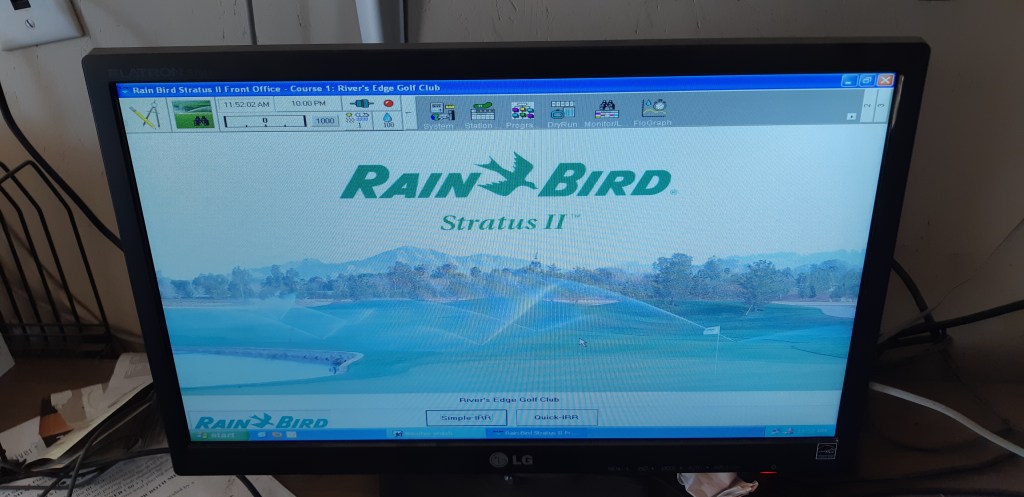
For the final week of TRF 2660 it has been a great experience to work with a great group to make instructional videos for how to use the Rain Bird Cirrus software. By making videos with group members it has taught me skills with editing videos and how to be more in depth with my understanding of Rain Bird and irrigation methods and delivery. It was interesting to see how the program manages water, pressure, and sprinkler systems. I think going forward I would like to learn more about the difference between the Toro and Rain Bird software, since Toro is the industry standard, it will be interesting to see how the Rain Bird software holds up.
TRF 2660 – Reflective Journal 1
My 2nd course at Olds for the 2nd year has allowed me to work with a few new irrigation aspects and technologies. Rain Bird type sprinklers are old news to me, but screw in fittings and metal clamps on the ploy was new. The 1 week spent on campus has been great to network and catch up with friends from last year, which has been so difficult with Covid. This block has showed me how experience and time with colleagues helps to develop your team work and efficiency together. Even working with people for the first time in the 2nd year, working towards achieving the goals of the class is easier and quicker. Moving forward in the class to the online section I look forward to working with my group and growing relations and growing my knowledge of the turf industry.
TRF 1760 – Final Journal
Reflecting back on the final class of the Turf Grass Certificate Program at Olds it is easy to see how the 3 aspects of analyzing turf conditions are related. All of the assignments are made to encourage you to explore deeper into the property you manage as a turf professional. Having a deeper understanding of the minor details of your course allows the superintendent the ability to better manage the course. This is since, most management decisions like fertilizer and pesticide applications are done based on an average of course conditions and characteristics. Therein, understand the hardest and easiest holes on your course, along with the people who play it and the grass they play on allows you the better understand how the decisions based on averages will effect the user. Of the 3 though, understanding your clientele would have to be the most important aspect of playing conditions. Since, if the member’s, public and board (aka those that pay the bills) are happy, the course is perfect to those who see it. Therefore, the course management that involves the most coordination with members will be the most efficient and productive.
TRF 1720 Reflective Journal
This marks the last week of my first field school within the Turfgrass Management Program at Olds College. One of the biggest things that I have learn’t and realized is important is time management. With the onset of COVID-19 and special practices at work, the time needed to manage a golf course has been increased. Furthermore, with more time needed at the course, the time to enjoy summer time and complete school work has been stressful. Add on the daily golf course issues or irrigation breaks, diseases and golfer management this summer has certainly had its challenges and extra projects to deal with. However, even though it is an added stress, having assignments and research to do in school helps to show me what the future of my career within turf care will look like. Most importantly, how to effectively manage my time and resources to put enough into the course and facility but also enough to have a healthy work life balance.
TRF 1660 – Reflective Journal Final
This first official online block has now almost been completed. Within the block there has been moments of frustration, worry and success. Frustration has occurred since with the online platform and google meets setup, work and life has unfortunately led me to miss a few lectures online. Worry occurred when I thought about my lack of understanding when I attempted some of the assignments after forgoing attendance at the lectures. And finally, success has come when I again realized my previous education at UBCO was critical in my understanding of basic concepts to irrigation. Firstly, the problem of sprinkler spacing at first had me stumped. But remembering Pythagorean Therm, it was easy for me to over complicate a process that would also be achieved by multiplying the hypotenuse by 0.866.
Furthermore, by drawing it out and consulting the rain bird textbook, calculating precipitation rate was easy to understand to once I figure out it was a rate over and area. Therefore, the last week of TRF 1660 has showed me that I am more than capable at solving problems using resources. By consulting literature, not becoming over whelmed, and drawing projects out with a plan, it is easy to solve and face problems. Moving forward, I aim to use this experience to remind me when I am faced with a problem I may not know the solution to and that may be overwhelming, to take a breath and break it into the basic concepts. Then after breaking an issue down into basic topics, like chemistry, physics, biology etec, I’ll brainstorm what I have learned and know about these topics that may be relevant to achieving a solution. Then, I can use the things I know and have learned to attack the issue and find a solution. In the end, the biggest thing is to have trust in myself and confidence in my knowledge to drive me forward in my career when I am faced with a problem:
TRF 1660 – Initial Reflective Journal
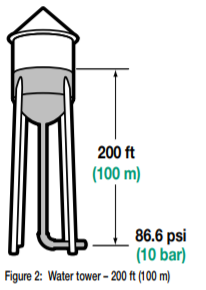
The first week of 1660 has been riddled with numerous obstacles. First and foremost, the poor timing of Covid-19 and the restrictive measures taken place due to the pandemic have lead 1660 a heavily hands on dependent class to become fully virtual. Despite this, adaptations have made a learning experience possible through the use of google meets and moodle. However, entering into the time of uncertainty when class was cancelled and moved online, my initial thought was the class would be best as an additional field school topic once the summer comes and courses are open. Interestingly, the concepts of pressure within an irrigation system are easy for me to pick up since they are closely related to calculations I have done while in Freshwater Science for roughness coefficients and stream modelling. Comparatively though, all of the units for irrigation are often done in imperial, such as feat and psi, whereas my knowledge and training was in metric. But, the formulas where easy to adapt the concepts I understand well. The take away I find for the future in this, is that you never know when a concept of the past will be beneficial to something important in the future. Therefore, it is important to pay attention and absorb all the information since it may beneficial beyond belief in the future.
TRF 1620 – Final Reflective Journal
The experience within the TRF 1620 PLAR CORE training class has been a one of a kind experience for sure. With the recent COVID-19 outbreak, preparation and preventative measures have moved the class training to an online format. However, the class was already predominantly online in preparation for the Pesticide Applicators exam which is still being permitted. The transition by me is actually much welcomed, since, with this course at Old’s inspiring me to learn and grow my knowledge of turfgrass, I have been chomping at the bit to get back on the grounds of River’s Edge. Therefore, the online delivery has not only given me more time to study, but also more time to work and have my hands in the business of the field. In terms of my actual reaction to the virus within the province, my life has mostly been unaffected. I am lucky I have a job at a small private barn during the school term and the golf course if marketed properly can be used as an escape for those out of work. Thus, I am remarkably fortunate and thankful for the opportunities I have in my life and the benefits they give. For the future, it will be important to think about how opportunities and changes in my career will benefit me during hard times such as we are in now. Moreover, it’s never a bad thing to think about the future, even when gas prices are at flashback prices.
TRF 1210 – Reflective Journal Final
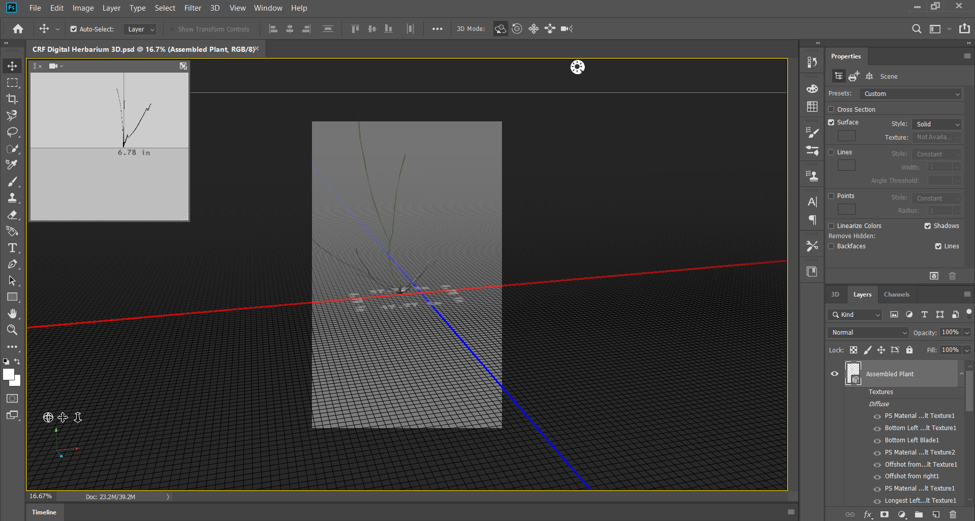
Within the second week of the TRF 1210 course within the Turfgrass Management Certificate program the most valuable and moving moment has been the ability and power of teamwork. For our second project and presentation, our group was tasked with becoming, as well as teaching the class to become experts on the grass species Creeping Red Fescue (Festuca rubra). Part of the project was to generate a method to develop a 3D model of Creeping Red Fescue, which I was put in charge of. Initially the method and process seemed daunting, but through my own self motivation, and my groups support, I quickly developed a rough 3D model using photoshop. However, this motivation is not what has stuck with me most during this block. What has inspired me the most, is the ability for my group to improve and grow our presentation for this project into something of an example. After seeing many groups go before us on Monday, our group was feeling a bit overwhelmed with the complexity and in depth expectations. Furthermore, we all felt the pressure of the increased expectations we knew we incurred by presenting a day later than the other groups. Against our doubts, my group quickly supported and motivated each other Monday afternoon to focus and expand our presentation into new horizons.
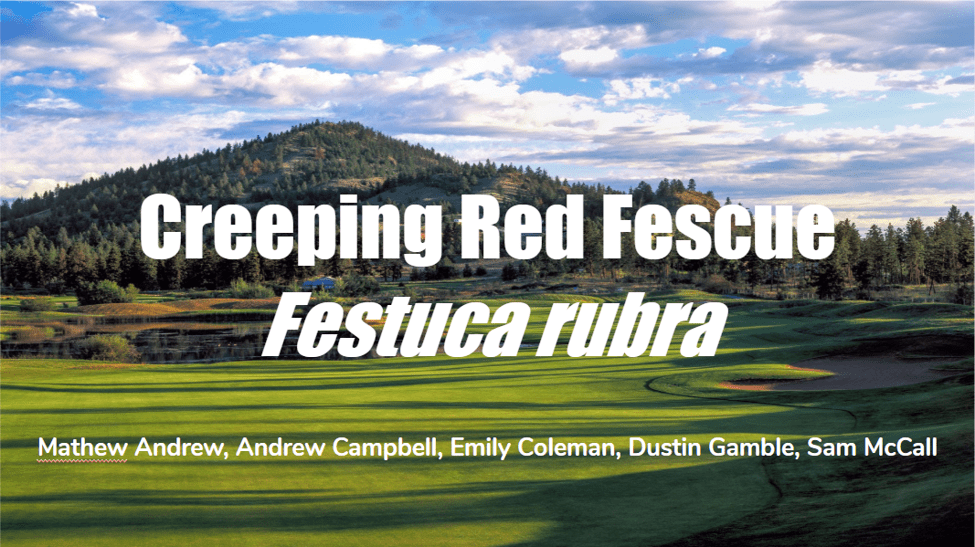
Going into the presentation, we all still felt nervous to examination but our presentation went smoothly and all the pieces fell into place. In the end, our mark reflected our effort and we all exceeded our own expectations. In the future, I want to remember and implement my groups ability to build a strong support web that allowed all of us the comfort to discuss, build and design our presentation. Our teamwork and determination has set the bar high which challenges us in the future to exceed and develop our potential. This will help me in my career, since, being a part of building and participating in a strong team setting gives me an example for what to do in my turfgrass management career.
TRF 1210 Reflective Journal Week 1
Through the first week of the TRF 1210 class at Olds college the critical info that has stuck out to me has been the new information about turf grass physiology. This is important to me since the process of turf identification will be incredibly important over my career in the turfgrass industry. This is since, grass is not just grass. At each golf course, there is often multiple species of grass over the property; differing between the greens, tees, fairways and rough. Furthermore, within each species is different strains and cultivars which prefer different conditions, mediums and irrigation. Therefore, having a better understanding of the types of grasses on the facility I am employed at will make cultural practices and daily operations more efficient and effective to the turf. This is since by knowing the specific needs and characteristics of the different types of grasses, it will be easier to tailor activities to the areas that have certain grasses. For instance, bentgrass greens will require different attention compared to Kentucky bluegrass.

In addition to turf identification and management skills, the course has also challenged me to attempt to build a 3D model of Creeping Red Fescue (CRF) that would allow you to interact with the plant in order to see its defining characteristics. The initial method of 3D scanning a sample of CRF was unsuccessful and my plan moving forward is to attempt to create the plant digitally using Photoshop’s 3D capabilities. However, I have very limited artistic abilities and replication of real world objects is often very challenging to me. Therein, the concept and process seems daunting and overwhelming to me, however, I have inspired myself to try my hardest and not be afraid to fail. I have motivated myself to feel like I can do anything, rather than limiting myself to feel like it’s too much for me. I am eager to see the result and feel like I am capable of anything if I put my mind to it.
 My Turfgrass Adventure